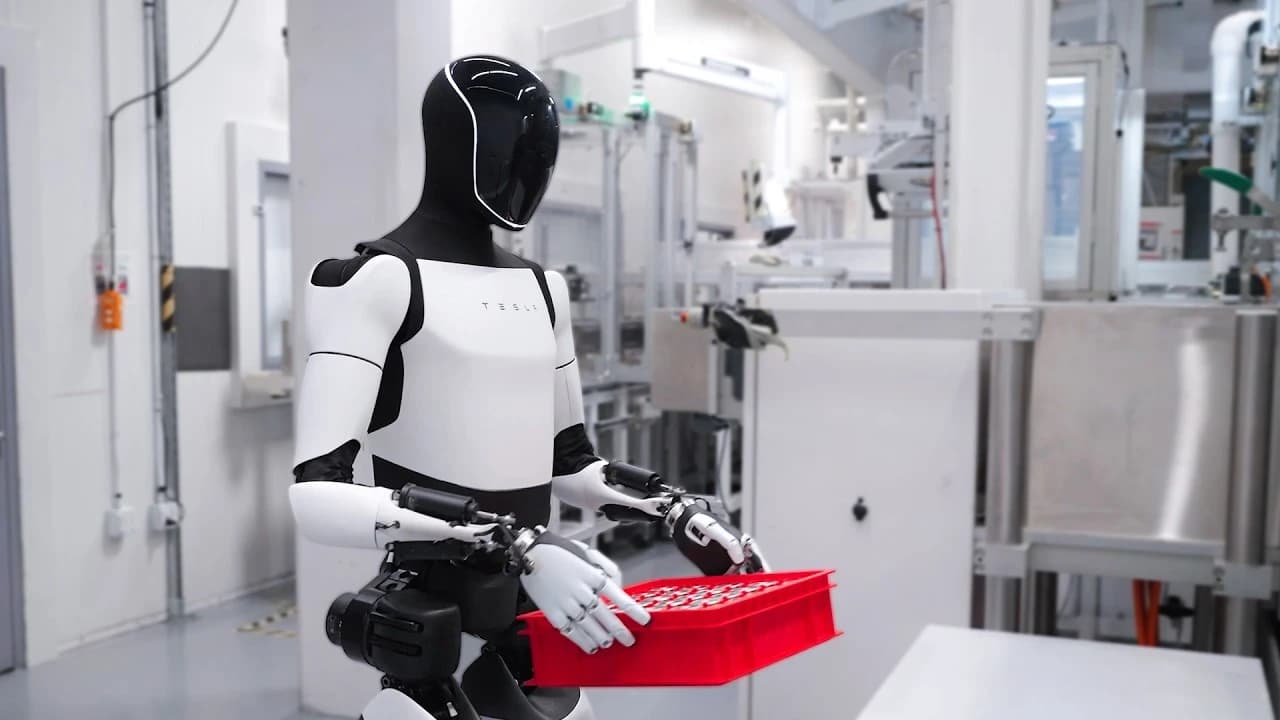

Companies that build software on rented intelligence are discovering, in measurable numbers, that the intelligence was the product. In Physical AI the lesson arrives faster and cuts deeper, because a robot's competence is set by data that does not exist on the internet, and whoever owns that data owns the robot.
This summer put the ownership argument on the record. On July 24, 2026, more than 25 organizations, among them NVIDIA, Microsoft, Meta, IBM, Hugging Face, Mistral, Mozilla, CrowdStrike, Palantir, Perplexity, Y Combinator, and the Linux Foundation, signed a coalition letter titled "Open Weights and American AI Leadership," which NVIDIA CEO Jensen Huang backed with his first post on X. Days later in Washington he told reporters that "we need open weight for security, we need open weight for safety." Satya Nadella made the company-level version explicit in a June 27 interview: "you can't outsource your learning." This post translates that argument to robotics, where it is stronger than in language, and lays out what a robotics company should own, what it should rent, and what layer makes ownership possible.
In language models, the shift is already measurable
Four forces push companies from renting to owning: cost, latency, domain performance, and control of their own destiny. Each has a number attached now.
Cost. AI-native gross margins sit structurally below software. ICONIQ's January 2026 survey of roughly 300 software executives put expected 2026 AI product gross margin at about 52 percent, up from 45 percent in 2025 and 41 in 2024, against 80 to 90 percent for classic SaaS, with inference alone running around 23 percent of revenue at scale. The offsetting force is deflation in inference: a16z's analysis found that for language models of equivalent capability, cost fell roughly 10x a year, from about $60 per million tokens in 2021 to about $0.06 three years later. Self-hosting an open model pays only above a break-even of roughly 2 million tokens a day (one reported fintech case cut monthly spend 83 percent, from $47,000 to $8,000); below that, APIs win. The rule is utilization, not ideology.
Performance. Open-weight models have closed most of the gap with the closed frontier. By mid-2026 the difference between the best open and closed models narrowed to roughly six points on the Artificial Analysis Intelligence Index, from about 13 a year earlier, and the LMArena Elo gap compressed from roughly 150 points to about 30 (reported). GLM-5.2 ranked first among open-weight models on that index; Kimi K3, with 2.8 trillion total parameters, 104 billion active, and a 1 million token context, published weights on July 27. Huang's figure at CES 2026 was that one in four tokens generated today comes from an open model.
Latency and control follow from these. When a small distilled model on your own hardware beats a large rented one on your task, the rent is paying for capability you do not use and a dependency you do not control. That is the language-model version. The robotics version is sharper on every axis.
The four forces are stronger in Physical AI
There is no internet of robot actions. Bessemer's April 2026 robotics report estimates total global robot manipulation data at roughly 300,000 hours, against about 1 billion hours of internet video and 300 trillion tokens of text, and projects aggregate robotic data costs across the industry above $3 billion over the next two years. Robot data cannot be scraped; it is generated task by task and environment by environment. That inverts the language-model dynamic. Foxglove CEO Adrian Macneil put it plainly in the same report: the defining advantage in physical AI will not be model novelty. The debate is live, and Perceptron CEO Armen Aghajanyan argues the opposite emphasis, that companies collecting demonstrations and fine-tuning policies "will not scale." We take the data position and return to his objection below.
Cost. Teleoperation is the expensive path. Reported all-in operator cost runs $28 to 60 per hour for competent operators and $80 to 150 for specialist bimanual work, yielding 5 to 50 usable episodes per operator-hour, on rigs near $20,000 per station. The Robotics Center of Silicon Valley's State of Robotics 2025 found the cost of an hour of high-quality teleoperation data, captured, labeled, and packaged, fell from about $340 in early 2024 to $136 by the fourth quarter of 2025. The 2025 Data Utilization Law paper estimated that roughly eight simulation samples deliver the benefit of one teleoperated sample for in-domain manipulation. A company that owns a diversified collection pipeline, egocentric plus fleet, is buying at the cheap end of every one of those curves; a company renting undifferentiated teleop hours is buying at the expensive end and owns nothing afterward.
Latency. On-robot control loops run at 10 to 50 Hz, so a cloud round trip cannot close the loop; inference runs at the edge or it does not run. NVIDIA's Jetson Thor T5000 delivers up to 2,070 FP4 TFLOPS in roughly 130 watts with 128 GB of memory, about 7.5x the compute and 3.5x the efficiency of AGX Orin's 275 TFLOPS, and NVIDIA ships a 4 billion parameter Cosmos 3 Edge model for on-device inference. Bessemer's own analysis notes the structural difference from text: a robot must generate an environment state every few milliseconds, so each deployment effectively needs a dedicated inference pipeline rather than a batched API. A rented model you cannot quantize, distill, and deploy on your own compute module is not a robot policy.
Performance. Evidence that post-training on your own embodiment beats a general model is now concrete, though largely vendor-reported. Dyna Robotics' DYNA-2 (August 2026) reported mean normalized performance across 14 tasks on three embodiments rising from 20 to 28 to 45 to 53 percent of ceiling as human-video pre-training scaled from 1,000 to 1 million hours, with a lockbox key-turning task going from 0 to 90 percent and bottle-cap untwisting reaching about 50 percent on roughly 10 minutes of robot demonstrations, and a customer-site pass rate of 87 percent against 46 for its predecessor. NVIDIA's GR00T N1.7 reports a dexterity scaling law from 20,854 hours of egocentric human video. Physical Intelligence's pi-0.5 demonstrated open-world generalization to unseen homes. In each case the general model supplies the prior and the embodiment-specific data supplies the performance.
Control. The canonical case is Figure. It signed a collaboration agreement with OpenAI on February 29, 2024, and CEO Brett Adcock ended it on February 4, 2025, unveiling the in-house Helix model weeks later. His reasoning, as reported: "We can't outsource AI for the same reason we can't outsource our hardware." Tesla shows the same instinct in driving, with an in-house data engine, shadow mode, auto-labeling, and custom silicon (AI5 taped out around April 2026), all in service of controlling the learning loop. Owning the loop is what lets you fix the failure you find at 2 a.m. instead of filing a ticket about it.
What is genuinely open to build on
Because the model layer is converging toward open, the best model a robotics company can fully own is the best open-weight one. Licensing matters more than benchmarks here, and it changes by version; the table reflects terms as of this writing.
| Model | What is open | License | Practical status |
|---|---|---|---|
| Physical Intelligence openpi (pi-0, pi-0.5) | Base checkpoints and fine-tuning code | Apache-2.0 code; checkpoints on public storage | Newer pi-0.6 and pi*-0.6 policies remain gated |
| NVIDIA Isaac GR00T N1.7 | Weights and code | Open Model License weights, Apache-2.0 code | Commercially licensed; LeRobot-format fine-tuning on Ampere through Blackwell and Jetson |
| NVIDIA Isaac GR00T N1.5 | Weights | Non-commercial | Research only |
| OpenVLA (7B) | Weights and code | Apache-2.0 | Fully open, self-hostable; the practical default for many teams |
| Meta V-JEPA 2 | Weights | Open | 1M+ hours video pre-training; 80% zero-shot pick-and-place with 62 hours of robot data (per Bessemer) |
| NVIDIA Cosmos | World foundation models | NVIDIA open license | Trained on 10,000 H100s over three months; heavy to reproduce, usable to build on |
A commercially licensed open base now exists at every layer of the robot stack; what no license supplies is the embodiment-specific data that turns the base into a policy.
Two cautions. GR00T N1 was relicensed from non-commercial to the Open Model License, N1.5 stayed non-commercial, and N1.7 is commercial; confirm the exact checkpoint license before building a product dependency on it. And an open base model with a rented, closed reasoning layer on top is still a rented stack at the point where it fails.
The development stack, mapped to robotics
In language, owning your intelligence means owning a development stack of four parts: evaluation, data and post-training, environments, and online learning. Each has a robotics equivalent, and each is where rented stacks quietly stop.
| Layer | Language-model version | Physical AI version |
|---|---|---|
| Evaluation | Held-out benchmarks, LLM-as-judge, A/B on traffic | Closed-loop real-robot trials, blind, off-team graders, production pass criteria |
| Data and post-training | Expert trajectories, preference pairs, SFT and DPO | Egocentric and fleet capture, 4D reconstruction, auto-labeling with human verification, versioned datasets under one record, embodiment post-training |
| Environments | RL environments, verifiers | Isaac Lab, MuJoCo, domain randomization, with real-data grounding for contact |
| Online learning | Learn from every user interaction | Learn from every deployment: on-policy data, interventions, failure mining |
Every layer of the language stack exists in robotics; the difference is that in robotics the data cannot be scraped and the evaluation cannot be simulated.
Evaluation. Offline metrics mislead badly. LIBERO-Plus (arXiv:2510.13626) showed vision-language-action model success dropping from 95 percent to below 30 under modest perturbations to camera viewpoint or initial state, with models often ignoring language entirely; LIBERO-PRO (arXiv:2510.03827) attributes much headline performance to memorization. Production-grade evaluation is closed-loop, on real hardware, blind, and graded by people who did not build the model. RoboArena (arXiv:2506.18123, CoRL 2025) is the credible pattern: double-blind pairwise comparisons across seven institutions on the DROID platform, more than 600 pairwise episodes across seven generalist policies, built because fixed tasks and centralized challenges do not scale.
Data. The pyramid runs from internet video and simulation, through egocentric human demonstration, to teleoperation and fleet data, refined by 4D reconstruction and Gaussian Splatting, sensor fusion and calibration, and auto-labeling with human verification, and ingested as MCAP (about 60 percent smaller than rosbag2 for the same content). We laid out per-layer costs in our buyer's guide to the robotics data pyramid.
Environments. Sim-to-real works for locomotion; manipulation contact dynamics, friction, deformation, and compliance remain open, which is why environments need real-data grounding rather than replacing it.
Online learning. Physical Intelligence's RECAP (arXiv:2511.14759), which produced pi*-0.6, trains advantage-conditioned policies on demonstrations, on-policy deployment data, and teleoperated interventions, and reported task throughput more than doubling and failure rate roughly halving on laundry folding in homes, box assembly, and espresso. Tesla's fleet flywheel with shadow mode is the mass-deployment analog. Neither is available to a company whose model is an API.
Provenance is becoming a precondition
Regulation is turning the ownership argument from a preference into a requirement. The EU AI Act's Article 10 data-governance obligations for high-risk systems entered application on August 2, 2026, requiring documented governance across collection, origin, annotation, labeling, cleaning, updating, enrichment, and aggregation, with datasets relevant, sufficiently representative, and as free of errors and complete as possible; Article 99 penalties reach 7 percent of global annual revenue at the top tier. ISO/PAS 8800:2024 treats every dataset as a versioned, traceable safety artifact, distinguishes training, validation, test, production, and field-monitoring sets, and requires traceability from system requirement down to dataset requirement. The EU Machinery Regulation applies from January 2027 and pulls high-risk AI-driven machinery into the same territory. Defense and government buyers add ITAR, air-gapped deployment, and FedRAMP.
The structural point is simple: you cannot document training data you do not control. A rented closed model makes these obligations difficult to satisfy and, for the strictest buyers, impossible. Owning the dataset record and the loop that writes to it is the cheapest way to satisfy all of them at once, because the provenance the regulation asks for becomes a byproduct of the record rather than a reconstruction after the fact.
For contrast, the nation-state version of this argument is already a market: NVIDIA reported roughly $30 billion in sovereign AI revenue in fiscal 2026, about 13.9 percent of $215.9 billion, across nearly 40 countries, and CFO Colette Kress framed it as every country building and operating some part of its own AI infrastructure. The company-level argument is the same logic one level down.
A roadmap: decide layer by layer
Sovereignty is not binary, and the failure mode is deciding it all at once. The sequence we recommend, with the trigger for each step:
- Decide own-versus-rent per layer. Own the data-to-model loop: the governed dataset record, post-training, and evaluation. Rent high-level reasoning and natural-language interfaces until domain evidence shows a post-trained open model beats the rented one on your task. Revisit any rented layer when it becomes a latency, cost, or compliance bottleneck.
- Build evaluation first. Closed-loop, real-robot, blind, off-team graders, production pass criteria. If a policy cannot hold performance under viewpoint and initial-state perturbation, its offline score is noise.
- Instrument the data-to-model loop as infrastructure. Give every dataset a durable identity from ingest: MCAP and ROS in, with versions, lineage, schemas, and permissions on one record, and auto-labeling plus expert verification as the quality gate. Measure accepted yield, not raw hours.
- Climb the post-training ladder deliberately. Evaluation, then harness and routing on an open base, then post-training on your own embodiment data, rarely mid- or pre-training, then an online loop from deployment. Self-host when utilization is steady, the robotics analog of the 2 million tokens a day threshold.
- Use regulation as the forcing function. If you sell into EU high-risk categories, defense, or government, provenance is the entry ticket, and the dataset record is where it lives.
The case against owning your stack
The strongest argument against is capital and timing. Building a research team is hard, most robotics startups should be buying rather than building, and premature vertical integration is a real failure mode: Tesla discontinued Dojo and revived it as Dojo3 within months. Bessemer's view is that horizontal robot foundation models are probably right but a 2028-and-beyond story, which means a company that owns its stack today is betting on timing as much as architecture.
Aghajanyan's objection deserves a direct answer. If the foundation model dominates and demonstration collectors do not scale, then the durable asset is the model, not the data, and the right move is to rent the best one. We think the DYNA-2 and RECAP results point the other way: the general model supplies priors, and every reported production gain came from embodiment-specific data and deployment loops the vendor owned. But this is a live disagreement, and the honest weakest point in our position is whether a third-party infrastructure partner remains the cheaper path once labs build their own control plane around in-house capture. This analysis favors what we sell, and readers should weight it accordingly.
Where Avala sits
Avala is Fleet Learning Infrastructure for Physical AI: one traceable loop from multimodal sensor data to models that improve, run in Avala Cloud today; BYOS keeps source data in your bucket and region. It is the layer a robotics company owns, distinct from the frontier reasoning it may rent.
Three parts make it sovereign in practice. The first is identity: sensor data, labels, schemas, permissions, and exports are versioned under one stable record a team can find, reproduce, and cite, which is the record a regulator asks for and the record a post-trained model traces back to. The second is the control plane: Mission Control coordinates ingest, visualization, human and AI labeling, quality control, publishing, drift monitoring, and re-labeling, with every stage writing back to the same governed record, and our 4D engine reconstructs LiDAR, radar, camera, and IMU streams into coherent scenes inside that loop. The third is managed execution: when a program needs throughput we supply it: egocentric and fleet collection through our own team and a partner network of homes and factories across the United States, and 15,000+ registered coworkers running consensus-based quality control, while the dataset identity and the control plane remain yours.
Ingestion is MCAP and ROS native across LiDAR, multi-camera video, and telemetry. Model management monitors drift, tracks real-world performance, and traces any prediction back to the training data that influenced it. The platform is SOC 2 Type I certified and GDPR compliant today, with ISO 27001 in progress, for the automotive and regulated buyers who need them, and the Python SDK, REST API, and CLI make every step scriptable.
The models are converging toward open. The compute is on your robot. The data, and the record that keeps your models connected to it, is the part nobody else can supply, and it is the part we help you own.
The path to global abundance runs through Physical AI. The path to Physical AI runs through ground truth. The path to ground truth runs through Avala.