

At Davos this week, Google DeepMind CEO Demis Hassabis made a prediction that should focus the attention of everyone building in Physical AI: "I think we're on the cusp of a kind of breakthrough moment in physical intelligence."
We believe him. We also believe the breakthrough will not be captured by the companies racing to deploy robots fastest, but by the ones building the infrastructure that turns every robot interaction into training signal. The binding constraint in Physical AI is not algorithms or hardware. It is data, and the data advantage is being decided now, before the moment arrives.
Hassabis is not offering the casual optimism of a conference keynote. He spent "a lot of the last year actually looking very carefully into robotics." He described gaining "a newfound appreciation for the human hand" and marveled at "how exquisite evolution's design is." He announced a deep collaboration with Boston Dynamics to apply AI to automotive manufacturing, and he explained that Gemini was made multimodal specifically so it could "understand the physical world" for robotics applications.
Physical AI is nearing every threshold at once
ChatGPT reached 100 million users in two months, the fastest consumer application adoption in history, because it crossed several thresholds simultaneously: reliability that "just works," accessibility to non-technical users, compelling demonstrations that shift public perception, and an ecosystem that compounds value over time. Physical AI is approaching each of these thresholds now.
Foundation models like RT-2, pi-zero, and Helix are enabling generalization across tasks that would have required separate systems two years ago. Manufacturing costs dropped 40% between 2023 and 2024, faster than the projected 15–20% annual decline, and Unitree's $16,000 humanoid already matches the annual cost of US minimum wage labor. The demonstrations are becoming genuinely impressive: Figure AI's robots logged over 90,000 parts loaded during an 11-month BMW pilot, and Agility's Digit achieved 98% task success moving 100,000 totes at Amazon facilities.
Capital has noticed. Goldman Sachs revised their humanoid robot market forecast sixfold, from $6 billion to $38 billion by 2035, driven specifically by AI acceleration, and Figure AI's valuation exploded from $2.6 billion to $39 billion in 18 months.
These numbers measure the size of the moment. They say nothing about who captures it.
The bottleneck is data
Hassabis was explicit about where the constraint lies: "I've always felt that the bottleneck in robotics isn't so much the hardware... but it's actually the software intelligence." And the bottleneck within that software intelligence? Data.
The data requirements for Physical AI dwarf those of digital AI. When Open X-Embodiment aggregated robotics datasets from 21 institutions in 2023, it assembled roughly 2,000 hours of robot data, the largest open-source real robot dataset ever created. GPT-3 trained on hundreds of billions of tokens scraped from the entire internet. This is not a gap that clever algorithms will close.
The gap is wider than it looks, because the physical world has effectively infinite edge cases. A door isn't just a door: it varies by weight, handle type, texture, reflectivity, lighting conditions, and the forces required to operate it. A partially occluded pedestrian might be a child about to run into the street or a mailbox with a coat draped over it.
Tesla's fleet experiences "a lifetime of driving scenarios in 10 minutes" across more than 6 million vehicles. Robotics companies don't have millions of robots collecting data, so the contest turns on extraction: how much learning a company can wring from every interaction it does get.
Autonomous vehicles already ran this experiment
The AV industry supplies both the warning and the playbook. The warning: Elon Musk predicted fully autonomous driving by 2018. Then 2019. Then 2020. In 2019, Tesla promised "1 million robotaxis" by 2020. None materialized. A 2024 lawsuit was dismissed when Tesla's lawyers successfully argued Musk's predictions were "corporate puffery."
The lesson isn't that Physical AI will fail: it's that the "last 10%" is brutally hard. Reaching 90% reliability is impressive. Reaching 99% is useful. Reaching 99.99% is what deployment requires. Closing that gap requires infrastructure most companies haven't built.
The playbook: the companies that succeeded, Tesla, Waymo, and a small number of others, didn't just build better algorithms. They built data flywheels that converted every mile driven into training signal. Tesla's shadow mode runs AI silently in the background, comparing its decisions to human drivers. Disagreements are flagged for review; engineer-defined triggers upload clips that are auto-labeled and used for retraining. Every vehicle contributes to a shared learning corpus, so the system never stops improving.
The result is over 7 billion cumulative FSD miles, including 2.5 billion city miles, what analysts describe as "a competitive moat nearly impossible for competitors to replicate." The moat is the flywheel's output, and it compounds. Copy that, not the robotaxi timeline.
Simulation alone will not close the gap
The "reality gap" (where models trained in simulation fail when deployed on physical robots) represents perhaps the most fundamental challenge in Physical AI. Domain randomization, which trains robots across randomized simulated environments hoping the real world falls within that distribution, has reached its limits. As one comprehensive survey concluded: "There is a consensus that further increasing the simulator's accuracy alone will not bridge this gap."
NVIDIA's simulation stack, Google DeepMind's Newton physics engine, and sophisticated digital twin systems all help. None fully captures contact-rich manipulation, deformable objects, real sensor noise patterns, or the chaos of human environments. This is why Hassabis noted that robotics needs to "work with less data" than digital AI while navigating greater complexity. Real-world data isn't optional: the companies succeeding in Physical AI combine simulation with systematic real-world collection, labeling, and learning.
Four capabilities that determine winners
After years working in data infrastructure for autonomous vehicles and Physical AI, we've identified four capabilities that separate the companies positioned to capture this breakthrough from those that will struggle.
A functioning data flywheel. Stanford research has formalized this as the "Robot-Powered Data Flywheel": robots perform useful tasks while collecting domain-representative data that improves both domain-specific adaptation and generalization. In one experiment, a mobile manipulator deployed in a library for two weeks improved VLM accuracy from 32% to 71.8% on book identification, just by doing its job while collecting data. The flywheel is the mechanism by which deployment creates compounding advantage rather than just revenue.
Observability that closes the loop. Physical AI observability differs fundamentally from traditional software monitoring: robots operate in non-stationary environments under hard real-time constraints. At 70 mph, an additional 100ms of latency increases stopping distance by 3 meters. Modern frameworks pair fast anomaly detectors that catch deviations in milliseconds with slower generative reasoners that assess safety implications. When Waymo deployed semantic interpretation for failure clustering, failure rates dropped from 46% to 18% after targeted intervention. This isn't monitoring: it's the mechanism that converts deployment into training data.
4D world data labeling at scale. A robot manipulating objects needs synchronized feeds from cameras, LiDAR, radar, IMUs, and tactile sensors, all temporally aligned and spatially calibrated. The emerging paradigm is 4D data: three spatial dimensions plus time, capturing not just what the world looks like but how it evolves. Point cloud annotation at this scale is expensive: autonomous vehicle perception projects run 6–8 months, annotation alone consumes 25–30% of that time, and production quality targets exceed 99% accuracy. Crowdsourcing doesn't solve this. It takes managed teams with domain expertise, hybrid approaches combining automation with human review, and systematic quality control.
Policy training infrastructure that goes beyond demonstrations. Diffusion policies have emerged as the dominant paradigm for manipulation, but demonstrations alone create distribution shift: when robots encounter states the expert never visited, small errors compound catastrophically. The importance of "what not to do" data is increasingly recognized: Tesla's shadow mode specifically captures disagreements between AI and human decisions, and safety constraints must be learned from near-miss data, recovery behaviors, and boundary cases. Human feedback remains essential; the challenge is capturing it efficiently and converting it into training signal.
The window is now
The technical advances are real and accelerating, manufacturing costs are collapsing, and labor shortages are creating genuine demand: 1.9 million manufacturing jobs could go unfilled by 2033, a $1 trillion economic cost.
But the ChatGPT moment for Physical AI will not reward whoever crosses the capability threshold first. It will reward whoever built the systems that keep improving after the threshold is crossed. Tesla's moat took a decade to build. The humanoid robotics companies and Physical AI startups launching today don't have a decade: the data advantage has to be built now, while the market is still forming, or it will belong to someone else.
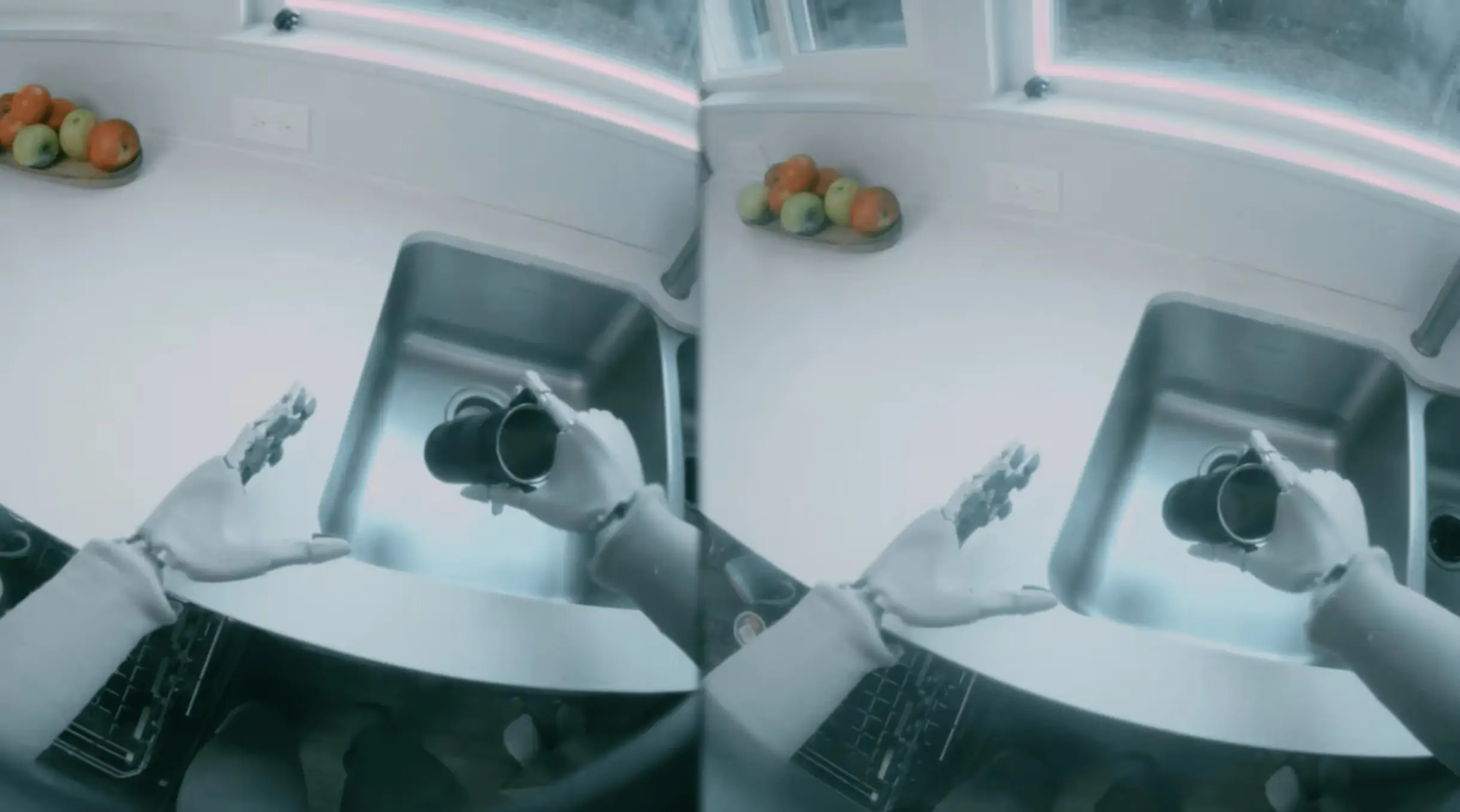
The image above is from Bicentennial Man (1999), a film our founder has loved since childhood, and one that imagines a future where robots become part of the family. We're getting closer to that world than most people realize. The question is whether we build the infrastructure to get there safely.