

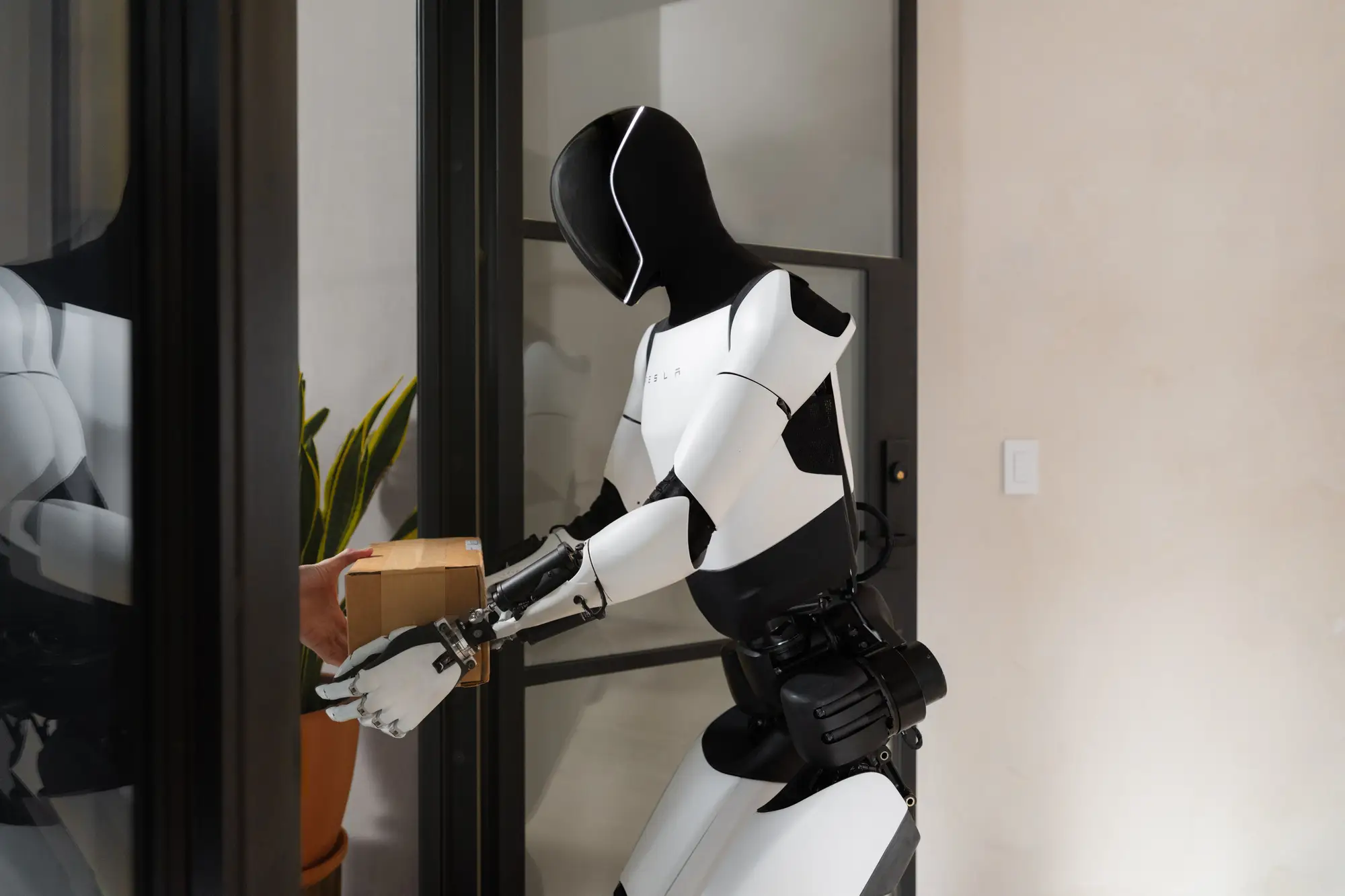
If you want to understand where humanoid robotics is headed, job postings tell you more than press releases. Tesla is hiring teleoperation specialists at $48 per hour to remotely control Optimus robots and generate training data, and that posting says more about the state of the field than any keynote.
The signal is clear: despite billions invested in simulation, despite breakthroughs in reinforcement learning, despite increasingly sophisticated physics engines, the path to capable humanoid robots still runs through human beings demonstrating the movements, manipulations, and behaviors that robots need to learn. This isn't a stopgap. It's the strategy. And we believe it points to where the durable advantage in humanoid AI will actually sit: not in the robot, but in the demonstration-data pipeline behind it.
Hundreds of millions of hours, at $48 an hour
The job postings are straightforward. Tesla is seeking specialists who will wear motion capture equipment and control Optimus robots remotely, demonstrating tasks the robots will learn to perform autonomously. The $48/hour rate (roughly $100,000 annually for full-time work) reflects both the skill required and the strategic weight Tesla places on this data.
Reports suggest Tesla is hiring 50 or more specialists, with plans to scale significantly, toward a goal of collecting hundreds of millions of hours of movement data. For perspective: 100 teleoperators working full-time for a year generate roughly 200,000 hours. Reaching hundreds of millions of hours requires massive parallel scaling, years of sustained collection, or both. The compute side matches the ambition: Tesla reportedly projects that training Optimus will require 10x the compute they use for vehicle AI, and Tesla already operates one of the largest automotive AI training clusters in the world.
But compute is only useful if you have data to train on. That's where the teleoperators come in.
Simulation can't grip a door handle
Why can't Tesla just simulate this? They have world-class simulation from Autopilot development. NVIDIA's Isaac Sim can generate millions of synthetic trajectories. Reinforcement learning has produced impressive results in simulated environments. Why pay humans $48/hour to move robot arms around?
Because the gap between simulation and reality grows with task complexity. For locomotion on flat surfaces, simulation works reasonably well: the physics of walking can be modeled accurately enough that policies transfer to real robots with modest adaptation, as Boston Dynamics has shown with Atlas. Manipulation is different. When a robot hand grasps an object, the interaction involves contact dynamics that are notoriously difficult to simulate: friction that varies with surface texture, deformation of both gripper and object, forces that depend on precise geometry in ways that are hard to model. A grasp that works perfectly in the simulator can fail completely on the real robot.
Humanoids face this across their entire operational envelope. Picking up objects, opening doors, handling tools, navigating cluttered spaces: all of it involves contact dynamics simulation struggles to capture, and the more dexterous and general-purpose the robot, the more it needs real-world data. Tesla is paying humans to demonstrate not because simulation is useless, but because real demonstrations provide ground truth that simulation cannot.
$48/hour is a bet, not a wage
The rate itself is a signal. It sits well above typical gig economy wages for three reasons. Teleoperation is skilled work: controlling a humanoid through complex manipulation requires coordination, spatial awareness, and adaptation to latency and imperfect feedback, and the quality of demonstrations directly affects the quality of learned policies. The work is physically and cognitively demanding: motion capture equipment worn for hours, repetitive demonstrations performed with sustained focus. And Tesla is competing for talent: Figure AI, Sanctuary AI, 1X, and Apptronik face the same data challenge, and demand for skilled teleoperators will only grow.
Run the numbers and the conviction shows. At $48/hour against a target of hundreds of millions of hours, the data collection budget alone could exceed billions of dollars, before the robots, the motion capture systems, the pipeline, and the training compute. Tesla isn't experimenting with humanoid robots. They're building the data infrastructure for what they believe is a transformational technology.
Every serious humanoid program is making the same bet
Figure AI, valued at $39 billion as of September 2025, has built teleoperation capabilities that feed imitation learning pipelines, and has been explicit that human demonstration is central to their approach. Sanctuary AI describes their approach as "carbon-to-silicon" knowledge transfer: capturing human expertise through detailed motion capture and teleoperation. 1X, formerly Halodi Robotics, has deployed teleoperators to control their EVE robots in real commercial environments, learning from actual task performance rather than laboratory demonstrations.
The pattern is consistent. The leading humanoid programs are competing not just on hardware and algorithms, but on their ability to collect, process, and learn from human movement data at scale.
Simulation expands coverage; demonstration calibrates it
None of this makes simulation irrelevant. NVIDIA's GR00T Blueprint can generate 780,000 synthetic trajectories, equivalent to about nine months of continuous human demonstration, in eleven hours of compute. But NVIDIA's own GR00T N1 paper showed a 40% performance improvement from combining synthetic and real data over either alone. The logic is intuitive: simulation explores the space of possible movements far more extensively than demonstration could, while real demonstrations anchor learned policies to physical reality. Tesla almost certainly runs this hybrid. The $48/hour teleoperators are generating the real-world data that makes the simulated data useful.
The data budget is the timeline
The scale of Tesla's investment tells you what they expect. You don't hire hundreds of teleoperators and plan for hundreds of millions of hours if you expect humanoids to be solved in a year or two. Tesla's Autopilot flywheel took nearly a decade and billions of miles to reach meaningful scale, and humanoid manipulation is arguably harder than driving: roads are constrained and somewhat predictable, while a humanoid in general environments faces unlimited variability in objects, tasks, configurations, and failure modes.
So despite the current hype, widespread deployment of truly general-purpose humanoids is likely years away, and the companies investing most heavily in data infrastructure understand this best. They're building for a long game, not a quick demo.
The moat is the pipeline
Three implications follow. First, data infrastructure becomes the competitive moat: hardware can be copied or purchased and algorithms get published, but a pipeline for generating high-quality demonstration data across diverse tasks takes years to build. Second, human expertise remains central: teleoperators are encoding human skill into forms machines can learn from, and the difference between a good teleoperator and a mediocre one shows up directly in robot performance, which makes training, retention, and quality assurance as important as data volume. Third, the cost structure of humanoid AI is now visible: capable humanoids require sustained operational spending on data collection, not just R&D, which shifts the field toward organizations that can run large-scale data operations, not just brilliant research teams.
Tesla's $48/hour job posting is a small signal of a large shift. The robots that learn to operate reliably in the real world will be the ones trained on enough real-world data, collected by people who know how to move through it. The companies building that infrastructure now are making a bet on how humanoid AI develops. Tesla just told you how seriously they're taking it.
We build data infrastructure for Physical AI, including human demonstration pipelines for robotics and autonomous systems. If you're working on these challenges and want to compare approaches, reach out.
