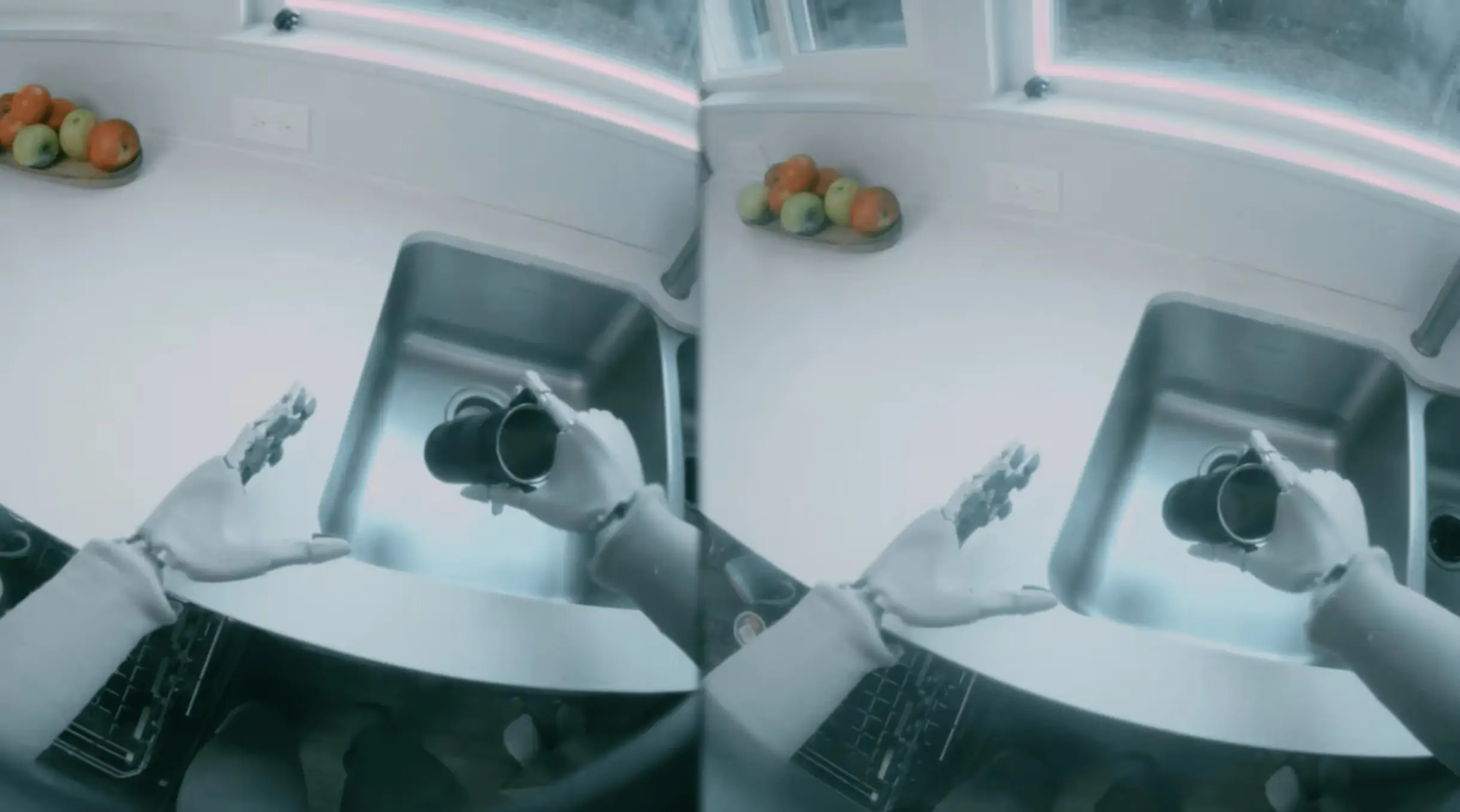

Most robotics models aren't learning about the world. They're learning about the data pipeline that describes it. That difference is behind failures anyone in robotics or embodied AI has probably encountered: a model that works beautifully in simulation, then behaves erratically on real hardware. A model that performs well on the test set, then fails on data from a slightly different sensor configuration. And, the subtle one, a model that learns behaviors that seem correct but turn out to be artifacts of how the data was collected rather than properties of the actual world.
The root cause is the same in each case: the pipeline feeding the model doesn't present a coherent picture of reality. Different sensors see different things. Timestamps drift. Objects appear and disappear between frames for reasons that have nothing to do with physics. The model learns to navigate that fragmented representation instead of learning about the world itself.
The 4D World-Data Engine is our answer: fuse all sensor streams into a single, temporally consistent representation of the world before any labeling or training happens. Everything downstream (annotations, training data, evaluation, simulation replay) references that unified model rather than the raw, conflicting sensor feeds.
Models learn the pipeline, not the world
A typical robot, whether a warehouse automation system, an autonomous vehicle, or a humanoid prototype, carries cameras for rich visual detail, LiDAR for precise depth, radar for velocity and weather resilience, and IMUs for motion and orientation. Each has its own characteristics, coordinate frames, failure modes, and slightly different view of the same scene.
The standard approach processes these streams separately (object detection on camera images, point cloud segmentation on LiDAR, tracking on radar returns), then merges the outputs downstream into a coherent picture: "the bounding box from the camera and the point cluster from the LiDAR probably refer to the same forklift."
This works, mostly. But it introduces a class of errors that are surprisingly hard to eliminate. Suppose the camera detects an object in frame 47 and the LiDAR detection doesn't fire until frame 49. Your tracking system has to decide: one object detected at different times, or two? If your timestamp synchronization is slightly off (it usually is, because sensor clocks drift), you make the wrong call. Multiply that across thousands of objects and millions of frames, and you get data where objects flicker in and out of existence, IDs switch unexpectedly, and the same physical entity has different properties depending on which sensor you ask.
Models trained on this data learn the flickering. They learn that objects sometimes teleport, that tracking IDs are unreliable, that the relationship between camera and LiDAR detections is probabilistic rather than deterministic. These aren't lessons about the world; they're lessons about the pipeline. And they make the model worse at operating in reality, where objects don't teleport and physics is consistent.
Evaluation compounds the damage. If training and test data were processed by different pipeline versions, or the same pipeline on different days, they carry different flickering patterns. Performance becomes sensitive to annotation artifacts rather than capability. You can't trust your metrics because you can't trust the ground truth they measure against.
Fusion first, labels second
Our engine inverts the standard pipeline: fuse the raw sensor data into a unified representation first, label second.
All these sensors observe the same physical world. A forklift is a forklift whether you're looking at RGB pixels, LiDAR returns, or radar reflections. Build a single model of that forklift (its shape, position, motion, and identity over time), and every sensor view becomes a projection of that underlying reality rather than a separate source of truth that needs reconciling.
We call this the Neural Digital Twin: a continuous 4D representation (three spatial dimensions plus time) capturing the geometry, appearance, and motion of everything in the scene. Ingestion isn't a stack of independent detection algorithms; it's asking "what configuration of the world would produce these sensor readings?" The twin is the answer.
Labeling then gets much cleaner. Annotators aren't drawing boxes on individual camera frames and hoping they match LiDAR annotations made by someone else. They label objects in the unified world model, and those labels project correctly onto every sensor view and every timestamp. An object labeled once is labeled everywhere.
Identity becomes stable for the same reason. The forklift that enters the scene in frame 100 and exits in frame 500 is the same forklift throughout, tracked not by heuristics matching detections across frames but by its continuous existence in the world model. The flickering disappears because there's nothing to flicker.
Time belongs in the representation
The "4D" in our engine name isn't marketing. Time is a first-class dimension in the representation, and treating it that way solves problems that are hard to address any other way.
Consider a person walking across a warehouse floor. Frame by frame, you detect them in frame 1, detect them again in frame 2, and run a tracker to associate the detections. If they're briefly occluded (they walk behind a shelf for half a second), the tracker has to guess whether the person who reappears is the one who disappeared. Sometimes it guesses wrong, and the ID switch propagates through everything downstream. In a 4D representation, the person isn't a sequence of detections to be stitched together; they're a continuous trajectory through space-time. Occlusion breaks nothing, because the model understands the person still exists while hidden, and identity is never ambiguous because the trajectory was never interrupted.
Deformable objects raise the stakes. A piece of cloth folding, a liquid sloshing, a cable swinging: these are hard to represent as rigid objects tracked over time because their shape is constantly changing. Traditional approaches either ignore the deformation (a rigid bounding box around cloth captures nothing about its behavior) or lose continuity when the shape changes too much between frames. We handle this with 4D Gaussian Splatting: oriented Gaussian primitives that move, rotate, scale, and deform over time. The cloth isn't a rigid box; it's a collection of splats that flow and fold with the actual fabric. The representation captures not just where objects are but how they move and change, which turns out to be critical for policies that interact with non-rigid objects.
A useful side effect: novel views. If your robot's camera pointed one direction during data collection but you want to train a policy for a different camera configuration, we synthesize what that camera would have seen by rendering from the 4D model. This isn't hallucination. We're not making up geometry that never existed; we're re-projecting observations we actually have into views we didn't happen to capture. It dramatically increases the diversity of training data you can generate from a single collection session.
Calibration is a process, not a setup step
None of this works if your sensors aren't synchronized and calibrated, and the hard truth is that synchronization is never perfect. Camera shutters have latency. LiDAR sweeps take time to complete, so different parts of the point cloud correspond to different moments. Radar returns accumulate over measurement windows. The IMU samples at its own clock rate, which may not match the spec sheet. Even with hardware synchronization, transport, buffering, and processing delays add milliseconds of uncertainty.
Milliseconds matter. At highway speeds, a car moves about 3 centimeters per millisecond; at walking speed, a person moves about half a centimeter. If your camera and LiDAR are 20 milliseconds out of sync (not unusual with software synchronization), objects appear in different places depending on which sensor you trust. Your model learns that the camera-world and the LiDAR-world are offset from each other: nonsense as physics, real as data.
Spatial calibration drifts the same way. Vibration loosens mounts. Temperature changes warp housings. Someone bumps the LiDAR during maintenance. Suddenly your carefully measured extrinsics (the parameters describing where each sensor sits on the robot) are off by a degree, and objects don't line up between sensors anymore.
So the engine treats calibration and synchronization as continuous processes, not one-time setup steps. At ingestion, we estimate time offsets by looking for correspondences: the same features observed by multiple sensors at supposedly the same moment. If they don't align, we infer the offset and correct for it. We refine spatial calibration online the same way, by checking how well the fused model explains the raw sensor data. If the LiDAR keeps putting objects slightly left of where the camera sees them, that's drift, and we estimate and correct for it.
Downstream processing then inherits clean geometry instead of compensating for alignment errors. Labels don't need to encode folk knowledge like "LiDAR bounding boxes are usually shifted a few centimeters right of camera boxes." They're just correct, because the underlying representation is correct.
One scaffold for training, evaluation, and replay
The most consequential property of the architecture: training data and evaluation data share the same world model. That sounds obvious. In practice it's remarkably rare. Training data goes through one pipeline version and test data through another. The team that collected training data six months ago followed one set of annotation guidelines; the team collecting test data today follows updated ones. Calibrations differ. These differences introduce systematic biases that make it hard to know whether your model is improving or learning to exploit quirks of your evaluation set.
When everything references the same scaffold, that problem disappears. Both world models are built by the same process, annotations mean the same thing, and identities follow the same logic. Performance on the test set genuinely reflects capability because the test set is genuinely comparable to the training set.
The scaffold extends to simulation and replay. To understand how your policy would behave in a scenario from your dataset (say, a near-miss you want to study), you replay it in the 4D model with accurate geometry and correct timing, then inject variations: what if the pedestrian had been walking faster? What if the lighting had been different? That's counterfactual simulation grounded in real observations rather than synthetic imagination.
It also makes safety regression testing straightforward. Every interesting failure (a human intervention, an unexpected policy behavior) is captured in the 4D model and added to a permanent test suite that new policy versions must pass before deployment. You're testing the same scenarios, not approximately similar ones corrupted by pipeline differences.
The binding constraint is trust, not volume
We built this infrastructure because we believe data quality, not data volume, is the binding constraint on embodied AI. Everyone in the field knows more data helps. What's less appreciated is that more data with inconsistent labeling, drifting calibration, and flickering object identities can actually hurt: the model learns the inconsistencies as if they were properties of the world, becomes robust to annotation noise instead of real-world variation, and passes benchmarks that inadvertently test pipeline consistency rather than capability.
This is infrastructure work, less glamorous than a new model architecture or a breakthrough in sim-to-real transfer. We've become convinced it's essential anyway. The teams making the fastest progress on embodied AI aren't the ones with the most data or the biggest models; they're the ones with data they can actually trust.
Working with us
We pair the 4D World-Data Engine with embedded engineers who integrate ingestion, quality assurance, and evaluation into your existing stack. The goal isn't to replace your pipeline; it's to give you a reliable foundation that keeps everything else honest. If you're fighting annotation inconsistencies, sensor synchronization issues, or evaluation metrics that don't track real-world performance, we'd be glad to compare notes.